3. kNNClassifier
3.1. Importing Packages
from mlots.models import kNNClassifier
from sklearn.model_selection import GridSearchCV
from scipy.io import arff
import matplotlib.pyplot as plt
import pandas as pd
import numpy as np
import warnings
from sklearn.metrics import accuracy_score
warnings.filterwarnings("ignore")
import matplotlib
%matplotlib inline
font = {'size'   : 22}

matplotlib.rc('font', **font)
3.2. Loading Data
Here we are loading the
PickupGestureWiimoteZ dataset.The datasets are in two
.arff files with pre-defined train and
test splits.The following code reads the two files stores the
X (time-series
data) and y (labels), into their specific train and test sets.
***name = "PickupGestureWiimoteZ"
dataset = arff.loadarff(f'../input/{name}/{name}_TRAIN.arff'.format(name=name))[0]
X_train = np.array(dataset.tolist(), dtype=np.float32)
y_train = X_train[: , -1]
X_train = X_train[:, :-1]
dataset = arff.loadarff(f'../input/{name}/{name}_TEST.arff'.format(name=name))[0]
X_test = np.array(dataset.tolist(), dtype=np.float32)
y_test = X_test[: , -1]
X_test = X_test[:, :-1]
#Converting target from bytes to integer
y_train = [int.from_bytes(el, "little") for el in y_train]
y_test = [int.from_bytes(el, "little") for el in y_test]
#Filling NaN/missing values with 0.0
X_train = np.nan_to_num(X_train, 0.0)
X_test = np.nan_to_num(X_test, 0.0)
X_train.shape, X_test.shape
((50, 361), (50, 361))
Set |
Sample size |
TS length |
|---|---|---|
Train |
50 |
361 |
Test |
50 |
361 |
3.3. Evaluating kNNClassifier
3.3.1. Default parameters
We would employ
kNNClassifier model from the mlots python
package.First, the model is evaluated with default parameters over the
PickupGestureWiimoteZ dataset. ***model_default = kNNClassifier().fit(X_train,y_train)
y_hat_default = model_default.predict(X_test)
acc_default = accuracy_score(y_test, y_hat_default)
print("Model accuracy with default parameters: ", round(acc_default, 2)*100)
Model accuracy with default parameters: 60.0
The accuracy of the model is 60%, which is better than random guessing. However, lets try tuning the model’s parameter now.
3.3.2. Model tuning
kNNClassifier model allows us to work with a more complex distance
measure like DTW in a MAC/FAC strategy.Here, we would use
GridSearchCV algorithm from the sklearn
package to find the best set of parameters of the model over the
dataset.The model tuning would be done only over the
train set of the
dataset. ***#Setting up the warping window grid of the DTW measure
dtw_params = []
for w_win in range(5,10,3):
dtw_params.append(
{
"global_constraint": "sakoe_chiba",
"sakoe_chiba_radius": w_win
}
)
dtw_params
[{'global_constraint': 'sakoe_chiba', 'sakoe_chiba_radius': 5},
 {'global_constraint': 'sakoe_chiba', 'sakoe_chiba_radius': 8}]
#Setting up the param grid for the kNNClassifier model with the DTW params

param_grid = {
    "n_neighbors": np.arange(1,10,2),
    "metric_params" : dtw_params
}
param_grid
{'n_neighbors': array([ 1,  3,  5,  7,  9]),
 'metric_params': [{'global_constraint': 'sakoe_chiba',
   'sakoe_chiba_radius': 5},
  {'global_constraint': 'sakoe_chiba', 'sakoe_chiba_radius': 8}]}
#Executing the GridSearchCv over the kNNClassifier model with the supplied param_grid.

model = kNNClassifier(mac_metric="dtw")
gscv = GridSearchCV(model, param_grid=param_grid, cv=5,
                    scoring="accuracy", n_jobs=-1).fit(X_train,y_train)
#Displaying the best parameters of kNNClassifier within the search grid.

best_param = gscv.best_params_
best_score = gscv.best_score_
print("Best Parameters: ", best_param)
print("Best Accuracy: ", best_score)
Best Parameters:  {'metric_params': {'global_constraint': 'sakoe_chiba', 'sakoe_chiba_radius': 5}, 'n_neighbors': 1}
Best Accuracy:  0.62
3.3.3. Evaluation of tuned model
The parameters displayed above are optimal set of parameters for the
kNNClassifier model over PickupGestureWiimoteZ dataset.Our next task is then to train the
kNNClassifier model over the
train set with the optimal set of parameters, and evaluate the
model over the held-out test set. ***model_tuned = kNNClassifier(**best_param,mac_metric="dtw").fit(X_train,y_train)
y_hat_tuned = model_tuned.predict(X_test)
acc_tuned = accuracy_score(y_test, y_hat_tuned)
print("Model accuracy with tuned parameters: ", round(acc_tuned, 2))
Model accuracy with tuned parameters: 0.7
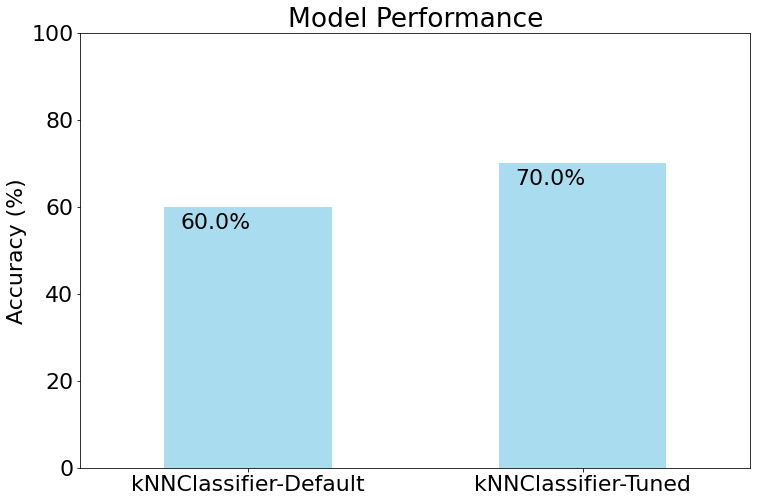
By tuning the parameters of the model we increased the accuracy of the model from \(60\%\) to \(70\%\).
3.4. Comparison
Here we do bar-plot that would illustrate the performance of the
kNNClassifier model with default parameters against the model
with the tuned parameters.The
matplotlib.pyplot is employed for this task. ***acc = [acc_default*100,acc_tuned*100]
rows = ["kNNClassifier-Default", "kNNClassifier-Tuned"]
df = pd.DataFrame({"models": rows, "Accuracy":acc})
fig = plt.figure()
ax = df['Accuracy'].plot(kind="bar", figsize=(12, 8), alpha=0.7,
color=[
'skyblue'
], label = "Accuracy")
ax.set_xticklabels(df['models'])
ax.set_ylabel("Accuracy (%)")
ax.set_ylim(0,100)
plt.setp(ax.xaxis.get_majorticklabels(), rotation=0)
for i,a in enumerate(acc):
ax.text(i-0.2,a-5,str(round(a,3))+"%")
plt.text
plt.title("Model Performance")
plt.show()